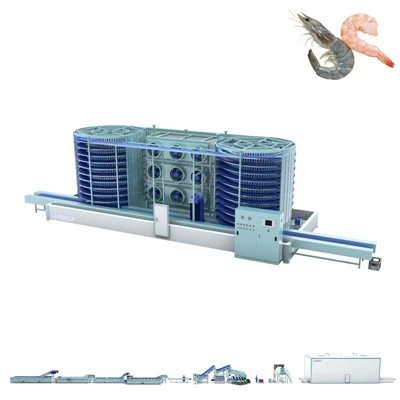


Fish and prepared seafood require more than a single freezing step. Product shape, protein structure, surface moisture, cooking status, and package format all influence the process route. Whole portions and fillets need careful transfer, while fish balls, fish tofu, surimi products, and other formed foods may require controlled cooking or blanching followed by rapid cooling before freezing.
A project-specific Fish Processing Line can connect bubble washing, optional mesh-belt blanching, normal-water pre-cooling, chilled-water cooling, air-blower drying, spiral quick freezing, ice glazing, and a re-freezing tunnel. The first freezing stage stabilizes product shape; glazing creates a protective ice layer; re-freezing sets that layer before weighing, packing, and frozen storage. Unnecessary modules can be bypassed when the raw material or finished product does not require them.

PROCESS AND PRODUCT ADVANTAGES
1. Continuous Temperature Control: Matched cooling and freezing stages reduce warm holding time between operations.
2. Flexible Seafood Routes: Fresh portions, cooked products, fish balls, and fish tofu can use different combinations of washing, heating, cooling, and freezing.
3. Surface Moisture Management: Air-blower drying reduces free water before the first freezing stage and supports more consistent surface quality.
4. Spiral Freezing Efficiency: A compact spiral conveyor provides extended freezing time while supporting continuous production and careful product handling.
5. Protective Ice Glazing: A controlled ice coating helps limit dehydration and surface oxidation during frozen storage.
6. Glaze Stabilization: The re-freezing stage sets the applied ice layer before downstream weighing and packing.
7. Expandable Line Integration: Inspection, grading, metal detection, weighing, bagging, cartoning, and cold-store conveying can be added to the system.


APPLICATIONS
The line is suitable for fish balls, fish tofu, surimi-based products, fish portions, fillets, prepared seafood, and selected cooked or coated items. Material 3 illustrates a modular seafood route using bubble washing, mesh-belt blanching, normal-water pre-cooling, chilled-water cooling with elevation, air-blower drying, spiral quick freezing, ice glazing, and re-freezing. The exact sequence depends on whether the product is raw or cooked, its dimensions and surface condition, the required glaze ratio, target capacity, storage period, and final package.
REFERENCE CONFIGURATION
|
Process Stage |
Typical Equipment |
Main Function |
|
1. Product Feeding |
Feed table or sanitary conveyor |
Introduces fish or formed products steadily to the selected process route. |
|
2. Washing |
Bubble washer |
Removes loose contamination with water circulation and gentle agitation. |
|
3. Inspection |
Selecting or trimming conveyor |
Allows visual checking, trimming, and removal of unsuitable products. |
|
4. Thermal Treatment |
Mesh-belt blancher (optional) |
Cooks or heat-treats products when required by the recipe. |
|
5. Initial Cooling |
Normal-temperature water pre-cooler |
Removes the first portion of heat after thermal processing. |
|
6. Chilled Cooling |
Ice-water pre-cooler with elevator |
Lowers product temperature further and transfers it to dewatering. |
|
7. Water Removal |
Drainage conveyor |
Removes carryover water before surface drying. |
|
8. Air Drying |
Air-blower dryer conveyor |
Reduces residual surface moisture before quick freezing. |
|
9. First Freezing |
Spiral quick freezing machine |
Quick-freezes the product continuously while stabilizing its shape. |
|
10. Ice Glazing |
Ice-glazing machine |
Applies a controlled protective ice layer to the frozen surface. |
|
11. Re-freezing |
Re-freezing machine |
Sets and stabilizes the glaze before final handling. |
|
12. Quality Control |
Inspection and metal detection |
Checks frozen condition and removes non-conforming packs or products. |
|
13. Packing |
Weighing and packing system |
Prepares finished products for cartoning and frozen storage. |
Q&A
Q: Which fish products can be processed on this line?
A: Typical products include fish balls, fish tofu, surimi foods, portions, fillets, and selected cooked or prepared seafood. The route is confirmed for each product.
Q: Does every project require blanching or cooking?
A: No. Thermal treatment is used only for products that require cooking, setting, or recipe-based heating. Raw fish products can bypass this section.
Q: Why are two cooling stages used after heat treatment?
A: Initial and chilled cooling remove heat quickly, stop further cooking, and lower the refrigeration load before the first freezing stage.
Q: What is the purpose of the air-blower dryer conveyor?
A: It removes residual surface water before freezing, helping improve surface condition and reduce unnecessary ice accumulation.
Q: Why is spiral freezing suitable for prepared seafood?
A: The spiral design provides long conveyor residence time in a compact footprint and supports continuous handling of portions or formed products.
Q: Why are glazing and re-freezing arranged after initial freezing?
A: The frozen surface receives a controlled ice coating, and re-freezing sets that coating to help protect the product during storage.
Q: Can weighing and packing equipment be integrated?
A: Yes. Inspection, metal detection, automatic weighing, bagging, cartoning, pallet handling, and cold-store conveying can be connected downstream.
Q: What information is needed for a proposal?
A: Please provide product type and size, raw or cooked condition, target capacity, inlet temperature, glaze requirement, package format, utilities, layout, and working schedule.
Hot Tags: fish processing line, China fish processing line manufacturers, suppliers, factory, Fish Meal Production Line, Fish Processing Line, seafood processing line, Shrimp Freezing Processing Line, Shrimp Processing Equipment, Shrimp Processing Line